Somerset is a
beautiful small town in south central Kentucky.
Located between
Lake
Cumberland,
the largest manmade lake in the
United States, and the
Daniel
Boone
National Forest,
the community draws nearly 1.5 million visitors each year.
First
United
Methodist
Church
meets in a striking mid-century modern building in the center of
the downtown.
The congregation has an active music
program under the direction of Ben Stapleton.
Since 1960, this music-making has
been supported by a three-manual Wicks pipe organ of 20 ranks.
 |
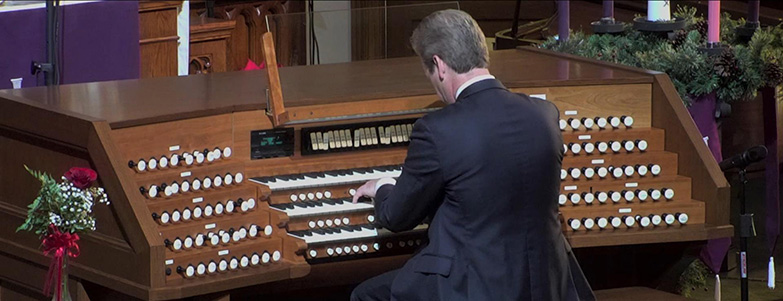
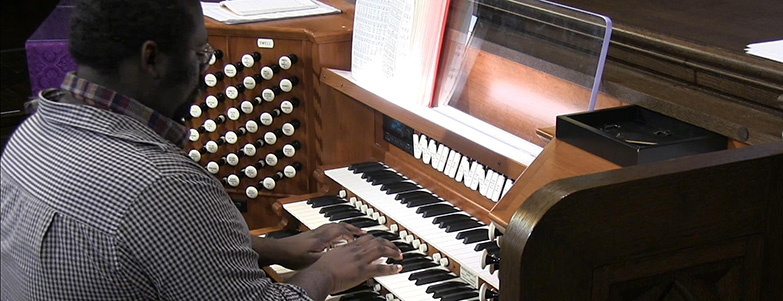
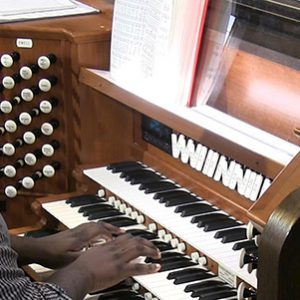
| Martin
Ellis at the console of the Somerset UMC organ. |
Following our completion in 2006 of a new
organ for First Presbyterian Church in
Somerset, Reynolds Associates was asked
to prepare a proposal for the renovation of the organ at First
United Methodist as part of a larger capital improvement project
in the church.
The
instrument presented several challenges.
The console and electromechanical
switching system were both worn out.
Typically for organs of this builder
and period, the sound of the instrument tended, in our view, to
be thin and harsh, and yet without enough fundamental power to
ring the building acoustically.
Previous tonal modifications to the
organ had made these problems worse instead of better.
The proposal
we presented to the congregation in April, 2006, included three
possible options.
Ultimately, after considering these,
the congregation decided on our 26-rank tonal redesign, which
also included a new console, renovation of the winding system,
and a Peterson ICS4000 solid-state integrated control system in
a new console.
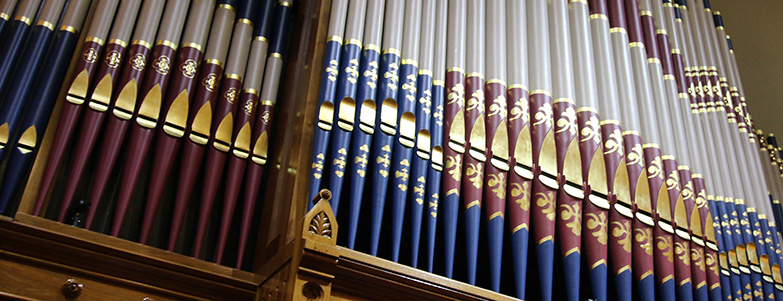
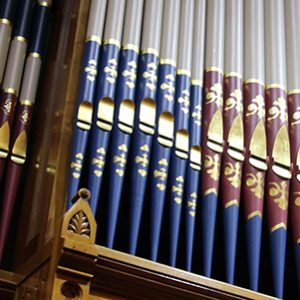
In our tonal redesign of
the organ, we replaced the principal ensemble with new pipes of
more appropriate scales.
Although thin ensemble elements can
often be rescaled with great success, we felt that new pipes
were needed to achieve a more distinguished and cohesive sound.
Since the principal ensemble defines
the basic character of an organ, the investment in these new
pipes is certainly worthwhile!
To provide the best
possible speech characteristics from these new pipes, we
replaced the toeboards on the Wicks windchests with new
toeboards constructed in our shop using our CNC manufacturing
process.
These new toeboards include
specially designed internal channels to quiet the turbulence of
the wind as it enters the pipes, and to eliminate the “popping”
sound that is sometimes heard in electromechanical windchests.
This toeboard design is critical to
good pipe speech, especially in the principals.
Along
with the new principal ensemble, we replaced the flutes in the
Great division.
In keeping with
our usual custom, we provided the organ with both an 8’
Rohrflöte of new pipes,
and an 8’ Offenflöte.
The Offenflöte is an open flute made
up of carefully restored and revoiced vintage pipes.
Its purpose is to provide a solo
flute presence in the Great, and also to darken and color the 8’
Principal, giving it the sound of an English Diapason.
The
Swell was recomposed, based on a new 4’ Spitzprincipal (also
playable at 8’).
The Fagotto was extended to 16’
using a 12-note electronic extension, which was also made
available in the Pedal.
A 1 3/5’ Tierce was added, making a
Cornet combination possible in the Swell to contrast with the 8’
Clarinet in the Choir.
The Choir division in the
existing organ had been a particular problem.
The original Wicks 8’ Spitzflöte had
been retuned as a celete stop for the Gemshorn, leaving the
organ with only the Gemshorn and Dulciana at 8’ in this
division.
There were no principal stops in the
Choir at all.
We
added a new 4’ Principal, and reestablished the Spitzflöte as an
8’ flute, strengthening its tone to make it more useful, and
more of a contrast to the Gemshorn.
We also added an 8’ Unda Maris,
which creates a warm undulation when played with the Dulciana.
The
new Pedal division includes a 16’ Gemshorn, extended
electronically from the 8’ Gemshorn in the Great.
Likewise, the Swell reed plays at
16’ and a 4’.
Martin Ellis, organist at North
United Methodist Church in Indianapolis, played the dedicatory
recital on the completed organ on Sunday, May 4, 2008.
See the old
and new specifications of this organ.
Hear this organ.