Menu Left Company Organs Service Projects News FAQ Contact Reynolds Menu Right
Left Pipe Organ


First United Methodist Church - Linton, IN

Small church: BIG DREAM!

There are those who think that a fine pipe organ is something to be found only in a large metropolitan church. The fact is, however, that there are many wonderful instruments in small churches in rural communities.

First United Methodist Church in Linton, IN, is such a church. The church's old pipe organ was in poor mechanical condition, and also had suffered damage to many of its pipes. Although organ pipes do not wear out with use, they can be damaged either by vandalism or by shoddy service.

When the opportunity came along to obtain a pipe organ from another church building that had closed, Reynolds Associates worked with the Linton congregation to put project together that would provide a new instrument for the church. Since the opportunity was immediate, a committee of dedicated volunteers raised much of the money for the organ in an informal phone campaign over one weekend!

Although the new organ consists of a combination of new and reconditioned pipes, all are voiced together to form a distinguished ensemble. Since organ pipes don't wear out (unless they are abused), the new organ at Linton will last for generations. The older pipes that were reused are of excellent manufacture, and in very good condition. They were thoroughly cleaned and reconditioned in the Reynolds shop before they were installed in the new organ.

The instrument consists of twenty ranks of pipes on two manuals and pedal. The organ has a full ensemble of Principal stops, three reed stops: a Clarinet, an Oboe, and a Trumpet, and a wealth of 16' pedal color that is unusual in an organ of this size.

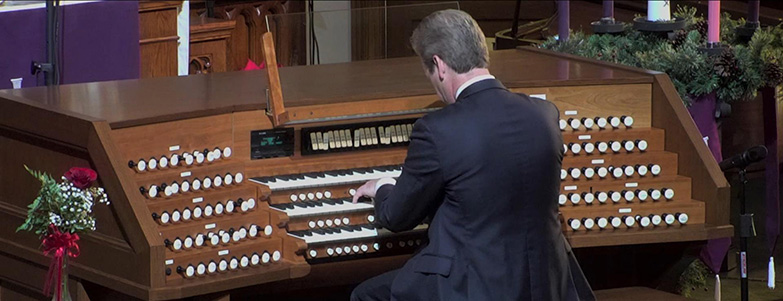
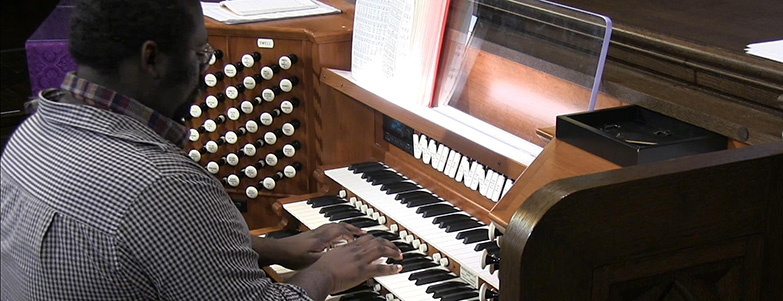
The Linton organ is controlled by a state-of-the-art Peterson ICS4000 control system, that includes a vast memory system to recall stop settings, and a full MIDI interface that gives the new organ an amazing musical flexibility to play both traditional and contemporary music.

But the Linton story doesn't end with the completion of the new pipe organ!

After the organ was dedicated, in an October 24, 2004 recital by the Rev. Robert Schilling, AAGO, the enthusiastic congregation added a second phase to their organ project that will vastly improve both the sound of the organ and the appearance of the room.

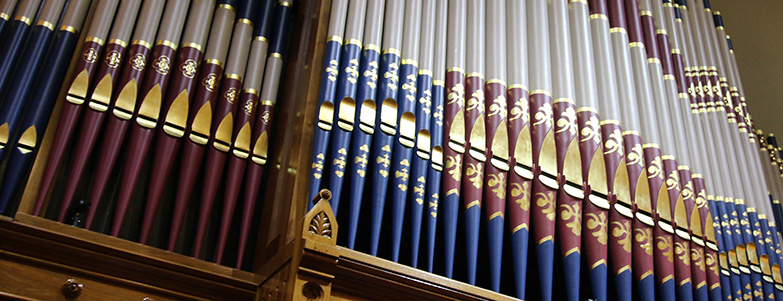
A design for new exposed Great division (drawing shown at top of page) was created by Michael Lenhart, our visual specialist. Michael's concept includes a new oak case that flanks the back of the platform, providing a visual link between the choir, the pulpit, and the lectern. Atop this case, the tin pipes of the new Great Principal chorus form a boldly sweeping pattern that echoes the lines of the ceiling. Bringing these pipes into the room will greatly enhance the sound of the organ, and give the front of the church an inspiring and dramatic new look.

The church board has approved this new project, and it is scheduled for completion in the spring of 2006.

The congregation at First United Methodist Church has embraced authenticity in their new pipe organ. Its magnificent sound will continue to enrich their worship experience for many, many years.

Linton Exposed Division Installed


A pipe organ can transform a worship space visually, as well as musically. 

When we completed the new organ for First United Methodist Church in Linton, IN in 2004, everyone involved agreed that a long-term goal would be the installation of an arrangement of exposed principal pipes to bring the ensemble sound of the organ out of the organ chamber, where its majesty and articulation could be more clearly heard.  That part of the project had to wait, however, for funding and for basic decisions to be made by the congregation about how the new platform would be configured.

The Linton folks didn't wait long!

Within a year of the completion of the original installation, this active, can-do congregation had found the funding for the new division, and had remodeled their platform to make it more flexible for their active worship experience.

The new chancel plan for the sanctuary at Linton is the third involving the pipe organ.  The original organ, a small tracker instrument, was placed behind a pipe fence of the sort that was typical in the late nineteenth and early twentieth centuries.

In the 1950s, the congregation followed a common trend, attempting to modernize the look of the sanctuary by placing the entire organ inside the organ chamber, with the pipes speaking through a screened opening.  This arrangement was poor for the sound of the organ, and eliminated the architectural interest provided by the exposed organ pipes.

In designing a new look for the new division of the new organ, Michael Lenhart faced several challenges.  The congregation could not afford to give up space on the busy chancel platform.  The ceiling presented complex visual lines in this corner where several roof planes intersect.  His visual plan, which was engineered and constructed by shop general manager David Reynolds, uses intersecting sweeps of pipes on a parabolic-shaped windchest that was constructed in our shop, and is more than twenty-four feet long!  For structural reasons, this windchest was constructed in a single piece.

The new organ pipes of 75% polished tin are arranged on this huge windchest, which in turn is supported on three large walls with inset panels.  Further structural support is provided by four heavy decorative brackets.  Although the walls take up only a few inches of depth on the chancel platform, the structure was entirely self-supporting, even before it was securely anchored to the building.  The largest display pipe is about 12 feet long; the smallest just a few inches.

The result is a magnificent visual focal point for the Linton sanctuary that successfully blends the traditional look of quarter-sawn oak paneling with the elegance of beautifully crafted organ pipes of polished tin.

Update:   A glance at the revised specification of the Linton organ shows that it has some unusual features.  While adding the new exposed Principal chorus to the organ, we decided to retain the existing enclosed ensemble because of its usefulness in many worship situations.  We also made the Pedal 8' Octave playable in the Great manual to give yet another scale option to the organist.

While this arrangement might not be appropriate in every situation, it gives this small two-manual organ the capabilities of a much larger instrument, with its multiple principal ensembles, both enclosed and unenclosed.  With careful voicing and regulation, we have been able to make this tonal design work without sacrificing articulation or clarity of musical line. 

With all the principal ensembles drawn at the same time, the organ has a warmth and gravitas that is unusal in a small instrument.

It is an honor to work with people of such vision and commitment!

View Organ Specifications
Hear this organ
Return to Our Organs

Return to Reynolds Associates Home Page

 
Footer Right
Reynolds Pipe Organs Reynolds Pipe Organs Reynolds Pipe Organs Reynolds Pipe Organs Reynolds Pipe Organs Reynolds Pipe Organs Reynolds Pipe Organs Reynolds Pipe Organs Reynolds Pipe Organs Reynolds Pipe Organs